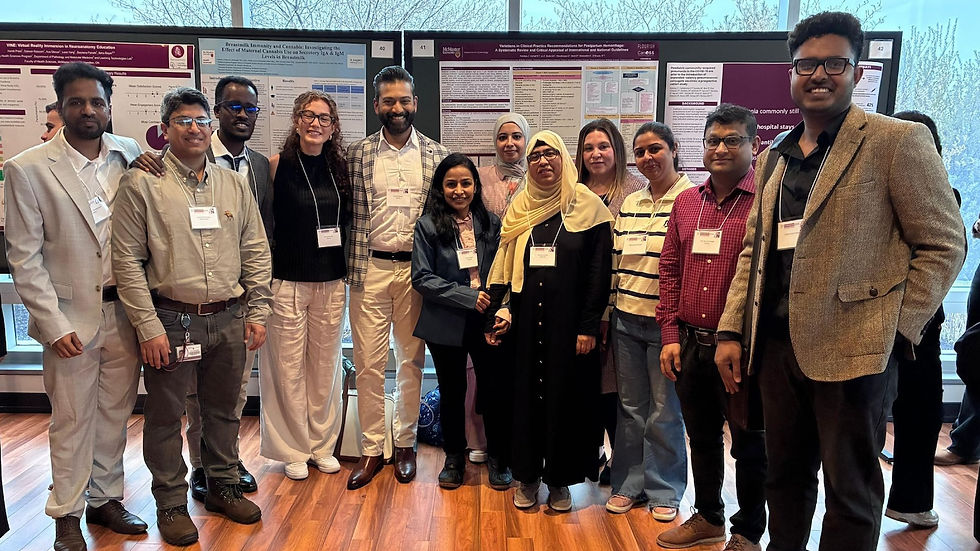
FLOURISH’s contribution to the Department of Health Research Methods, Evidence, and Impact’s 23rd annual Research Day reflected the range of work now underway across the group, from digital ethnography and post-pregnancy support to anticoagulation, HELLP syndrome, postpartum hemorrhage, and maternal sepsis surveillance.
Across two oral presentations and eight posters, presenters examined pregnancy and post-pregnancy care through questions of experience, evidence, clinical guidance, treatment, access, and surveillance.
The two oral presentations focused on care after pregnancy, with graduate student Vedha Viyas Thilagarajan supervising both projects. Sama Hasan, an Honours Life Sciences student, presented Understanding post-pregnancy experiences in Canada through digital ethnography with Prushti Patel, a first-year Health Sciences student. Their work examined how people describe and make sense of post-pregnancy life in digital spaces. Elizabet Liong, a Master of Public Health student, presented Environmental scan of post-pregnancy supports in Ontario with Crystal Li, an Honours Health Sciences student, and Adit Bhadri, an Honours Life Sciences student. Their project looked at the supports available after pregnancy and what that landscape may reveal about continuity of care beyond birth.
The poster presentations carried the work into the evidence, definitions, tools, and systems that shape pregnancy and post-pregnancy care.
Eisha Arvikar, a iBioMed student, and Lydia Su, an Honours Health Sciences student, presented Systematic survey of validated mental health screening tools for the post-pregnancy period, examining tools used to identify mental health needs after pregnancy.
Niki Banaei, a Biology and Pharmacology student, presented Rapid review of clinical practice guidelines for post-pregnancy care, reviewing how post-pregnancy care is addressed in clinical guidance.
Dr. Janki Pandya, Research Coordinator, presented A systematic review and critical appraisal of clinical practice recommendations for the prevention, detection, and treatment of postpartum hemorrhage, examining recommendations for prevention, detection, and treatment of one of the most serious complications in maternal health.
Jiadong Li, an international medical student, presented Global variations in definitions of postpartum hemorrhage: a scoping review of clinical practice guidelines, looking at how postpartum hemorrhage is defined across clinical practice guidelines and what variation may mean for measurement and care.
Dr. Rizwana Ashraf, a Masters student in Health Research Methodology, presented Anticoagulation for pregnant individuals with mechanical heart valves: a methodological review of systematic reviews, focused on evidence in a complex area of pregnancy care where clinical decisions carry significant risk.
Vedha Viyas Thilagarajan, a PhD student in Health Research Methodology, presented Corticosteroids for HELLP syndrome in pregnancy: a systematic review and meta-analysis, examining treatment evidence for a serious pregnancy complication involving hemolysis, elevated liver enzymes, and low platelets.
Emma Woolley, a Master of Public Health student, presented Navigating barriers to medication access in Ontario’s outpatient setting: a qualitative description exploring access to anticoagulation during pregnancy and postpartum, exploring barriers that can affect whether people are able to access treatment during pregnancy and after birth.
Hassan Rushekh Mahmood, a PhD student in Health Research Methodology, presented Initiating province-wide surveillance to reduce maternal mortality and severe morbidity from sepsis through the Canadian Obstetric Survey System, focused on surveillance to support earlier identification and reduction of severe maternal harm from sepsis.
“What connects these projects is their attention to the parts of care that are often studied separately, but experienced together,” said Rohan D’Souza, Scientific Director of the FLOURISH Group. “A person’s life after pregnancy, a clinical guideline, a definition, a treatment decision, a barrier to medication, and a surveillance system may appear to sit in different corners of research. In practice, they shape the same pathway of care. Seeing our students and team members work across that pathway is exactly what gives FLOURISH its strength.”
